
Putting the Brakes on Deepfakes
Seeking to control your image in the age of AI?
When actor Matthew McConaughey filed to register his likeness as a trademark with the U.S. Patent & Trademark Office in January, his lawyers acknowledged it was an untested strategy. U.S. trademark law does not explicitly recognize an individual’s likeness as a protectable mark.
A few celebrities have managed over the years to successfully assert a claim against an unauthorized use of an identifiable feature of their image or persona. In 1988, the Ninth Circuit Court of Appeals ruled that the “distinctive voice of a professional singer” is a protectable element of an individual’s identity under a common law right to control your image in a case brought by Bette Midler against Ford Motor over the use of an imitator in an ad (one of Midler’s own backup singers at the time, in fact).
Two years later, Tom Waits successfully challenged Frito-Lay over a copy-cat use of his signature gravel-throated vocal delivery in an ad, citing both voice misappropriation under California’s right-of-publicity law and false endorsement under the federal Lanham Act.
Other celebrities have succeeded in bringing similar cases under various state right-of-publicity or unfair trade practices law. But for now at least, federal law does not regard a person’s likeness as a form of intellectual property on par with a patent or copyright.
Bills to create such a right have been introduced in both the U.S. House and Senate, most notably the NO FAKES Act, but none have made it to a vote. Objections to the idea run from the fact that your face is not something you produced yourself (generally speaking) and therefore not a creative expression, to potential conflicts with free speech, such as in criticism or parody, to whether and where to draw the line between notable faces and everyone else.
The introduction of powerful AI applications, however, has made it trivially easy to create a digital replica of your own or anyone else’s face or voice and insert their apparent likeness into any scenario, real or imagined. that has altered the quantitative, if not necessarily qualitative terms of the debate, as malicious deepfakes of politicians, celebrities and athletes have poured out of AI-powered image generators.
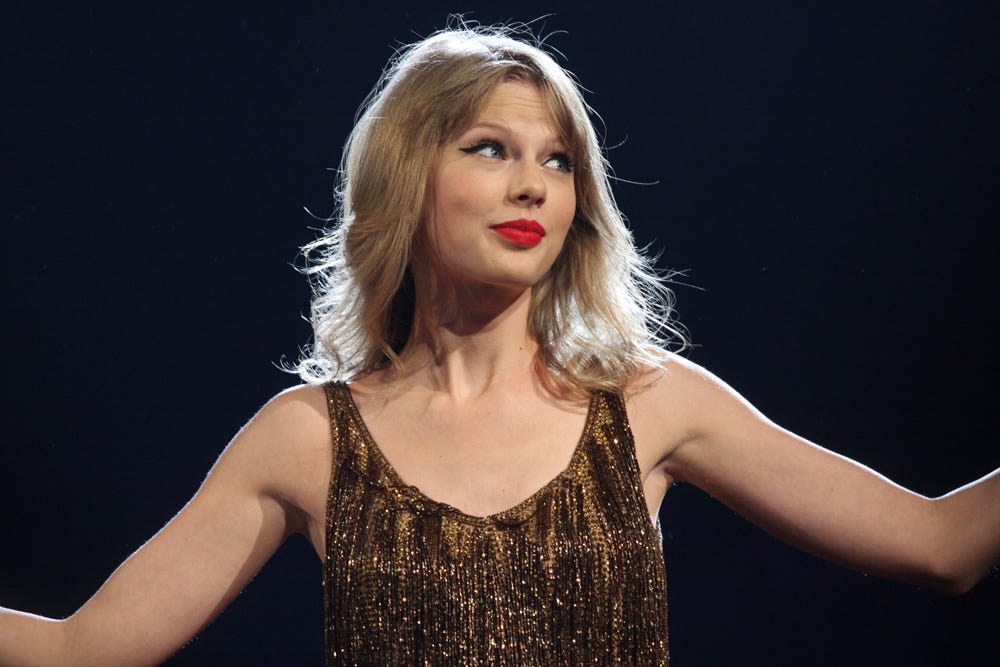
That was certainly a factor in prompting Taylor Swift to file an application to trademark her likeness and voice last month. As one of the most popular artists on the planet, whose every utterance, outfit, gesture and romantic engagement is minutely scrutinized by the celebrity press and her myriad legions of devoted fans, Swift has been a frequent target of deepfakes. She is also acutely aware of the monetary value of her celebrity as well as her music and attends to it assiduously. If there were ever an ideal test case for trying to trademark a person’s image it is Taylor Swift.
Even Taylor Swift, however, could only enforce her trademark against unauthorized uses as swiftly as the courts move, which is not swift, even for Swift. Given the sheer volume of unauthorized uses AI has unleashed, the case-by-case approach is neither practical nor effective. To be effective in the context of AI, rights need to be asserted, managed and enforced at the network level, on a machine-to-machine basis. That’s the goal of projects like Cloudflare’s managed-robots.txt system launched last year, WIPO’s Artificial Intelligence Infrastructure Interchange initiative and the RSL 1.0 technical standard with respect to copyrights.
Now, group of A-listers from the movie business took are trying to do the same for a person’s likeness, voice, and other personal and personality traits. Co-founded by actress Cate Blanchett, the group, calling itself RSL Media, this week launched a new non-profit that will administer a registry of works, personal identities, characters and protected marks linked to the new RSL Human Consent Standard.
The new standard — technically a module within the existing RSL (Real Simple Licensing) standard — will express “licensing terms that apply to identified Rights Subjects as abstract legal entities, rather than to individual digital assets,” in machine readable form, thereby “enabling consistent interpretation across training, reuse, redistribution, and AI-generated representations,” according to the group’s website.
Part of that interpretation will involve the “Evaluation of Rights Subject licensing terms by AI Systems and, where required, linkage to external authorization, licensing, or Clearance processes through license servers implementing the RSL-MEDIA Open License Protocol.”
“AI technologies are expanding rampantly, essentially unchecked and unregulated. In order for humans to remain in front of these technologies, consent must be the first consideration,” Blanchett said in a statement. “RSL Media is a simple, effective and free solutions-based technology for facilitating and activating consent. It’s also the industry’s first practical solution where people everywhere, not just public figures, can assert control over how their work is used by AI.”
Others involved at launch comprise a Mt. Rushmore of film and TV performers, including Javier Bardem, George Clooney, Viola Davis, Tom Hanks, Dame Helen Mirren, Steven Soderbergh, Kristen Stewart, Meryl Streep and Dame Emma Thompson, along with the Creative Artists Agency and the Music Artists Coalition.
Though new, RSL Media is not the first effort to create such a standard. The HAND ID standard, developed by HAND (Human and Digital) launched in 2024 and was recognized as an International Standards Organization (ISO) technical standard the following year. HAND ID is a digital object identifier (DOI) associated with a registry of legal-entity humans, their human likenesses and their animated characters for those seeking to license those assets for use in cultural products.
RSL Media is on the right track, by associating an individual with a machine-readable signal. The challenge it will face is compliance. Whereas HAND is designed for those figures seeking to proactively license their image and likeness, such as athletes with contractual rights to their name, image and likeness (NIL), RSL Media is designed to combat unauthorized uses.
RSL works in conjunction with robots.txt, which is a voluntary protocol that some bots honor and some bots don’t. As part of the RSL Consortium, Cloudflare and its managed-robots platform puts some teeth into robots by controlling access to websites at the network level. But at least in that case the right being asserted is unambiguously a legally defined and protected intellectual property right: copyright.
RSL Media faces the inverse of Taylor Swift’s dilemma. Even if Swift is granted a trademark, trademarks are not self-enforcing in a digital environment. Without a machine-readable mechanism to assert and enforce her trademark she is at the mercy of the legal system to protect it. RSL Media has developed a machine-readable mechanism for expressing rights in a person’s likeness, but that purported right is nowhere to be found in U.S. intellectual property law.